Agencies
Validate and prepare BAPLIE data for smooth port handover.
 BOTUNGA AI

BaplAI Engine scans every BAPLIE message as it arrives — checking positions, weights and partner codes, and flagging what needs a look before handover.
A vessel call connects carriers, agencies, terminals, planners and service providers — often using very different IT systems. SMDG standards provide the common framework, but daily operations add partner-specific codes, local conventions, legacy solutions and workarounds.
A BAPLIE that works for the sender may still create problems for the receiver.
Successfully created does not mean successfully processable.Default values, dummy codes and system-specific workarounds can make a file appear clean at the producing system. Its real quality may only become visible when another party imports it with different validation rules, master data and operational requirements.
Some problems remain hidden.A BAPLIE may technically load while operational or cargo-related information is ignored, skipped or interpreted differently. If the receiving system does not perform comprehensive checks, the person responsible may never be alerted.
Every exception adds friction.Once an issue is detected, teams need to investigate, clarify and correct it. Repeated communication, manual analysis and additional file exchanges consume human and technical resources and slow down the whole information chain.
New partner. New system. New integration effort.When a new party enters the process chain, individual codes, historical conventions and existing workarounds must often be detected, understood and implemented before reliable exchange can be established.
Integration knowledge often lives with people.Partner-specific codes and years of operational workarounds are frequently understood by only a few experienced employees. When that knowledge is unavailable, resolving BAPLIE issues becomes slower and more difficult.
Not every organization has the same system support.Large platforms may provide sophisticated validation and correction tools. Smaller agencies, operators and service providers often work with leaner systems and have fewer functions for analysing and efficiently correcting larger numbers of containers.
The BaplAI Editor creates an independent quality and correction layer.In the Vessel Control Room, users can see the quality of an EDI file directly, identify errors and warnings and work on the data without relying only on the capabilities of the producing or importing system. Corrections can be made on individual containers, multiple containers and on file or voyage level before the BAPLIE is revalidated and handed over.
Successful transmission is not the same as successful information exchange.
Visual reference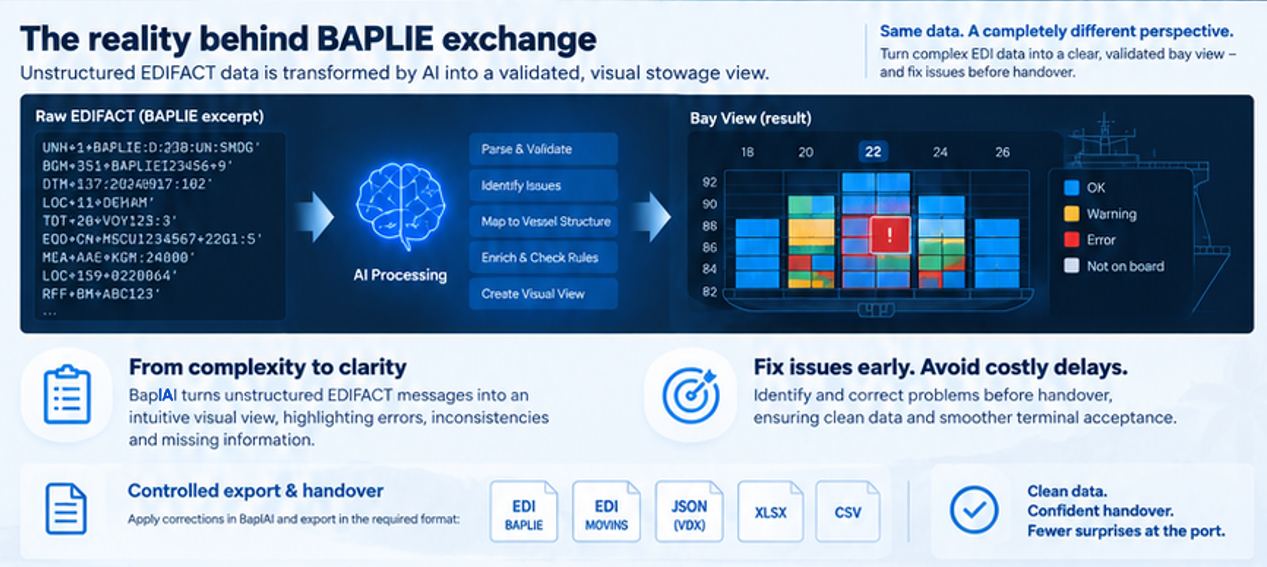
Get a fast operational overview of voyage details, container situation, validation status and EDI data consistency.

A configurable and flexible control room for voyage data, container situation and EDI consistency — designed for controlled maritime data handover.
The Vessel Control Room provides a consolidated overview of validation findings. From there, users can navigate directly into detailed issue views, inspect individual findings and apply targeted corrections. Recurring or systematic problems can be handled through controlled bulk-correction workflows before revalidation and handover.
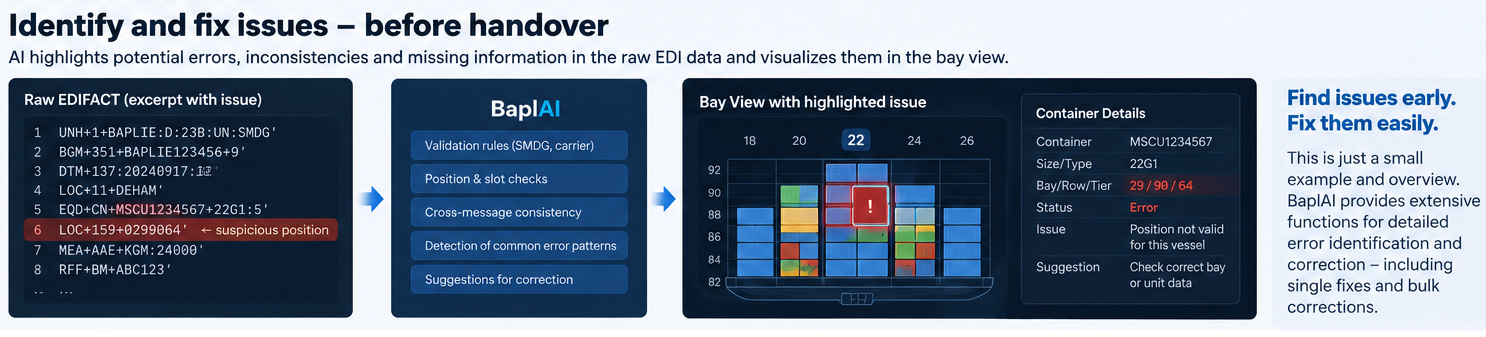
Illustrative excerpt. The full editor provides additional filters, detailed issue views and correction functions for individual findings as well as controlled mass corrections.
BaplAI Editor structures BAPLIE data, surfaces validation results, supports selected corrections and revalidation, and keeps the handover process controlled.
Version-aware BAPLIE handling supports SMDG 2.2 & SMDG 3.1.
Raw EDIFACT data is parsed, validated and mapped to the vessel structure, turning complex message content into a clear visual stowage view.
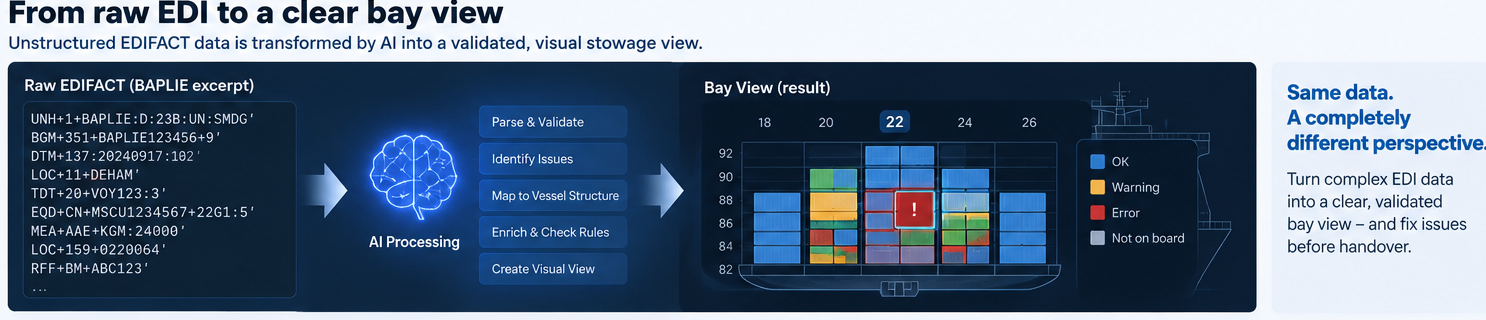
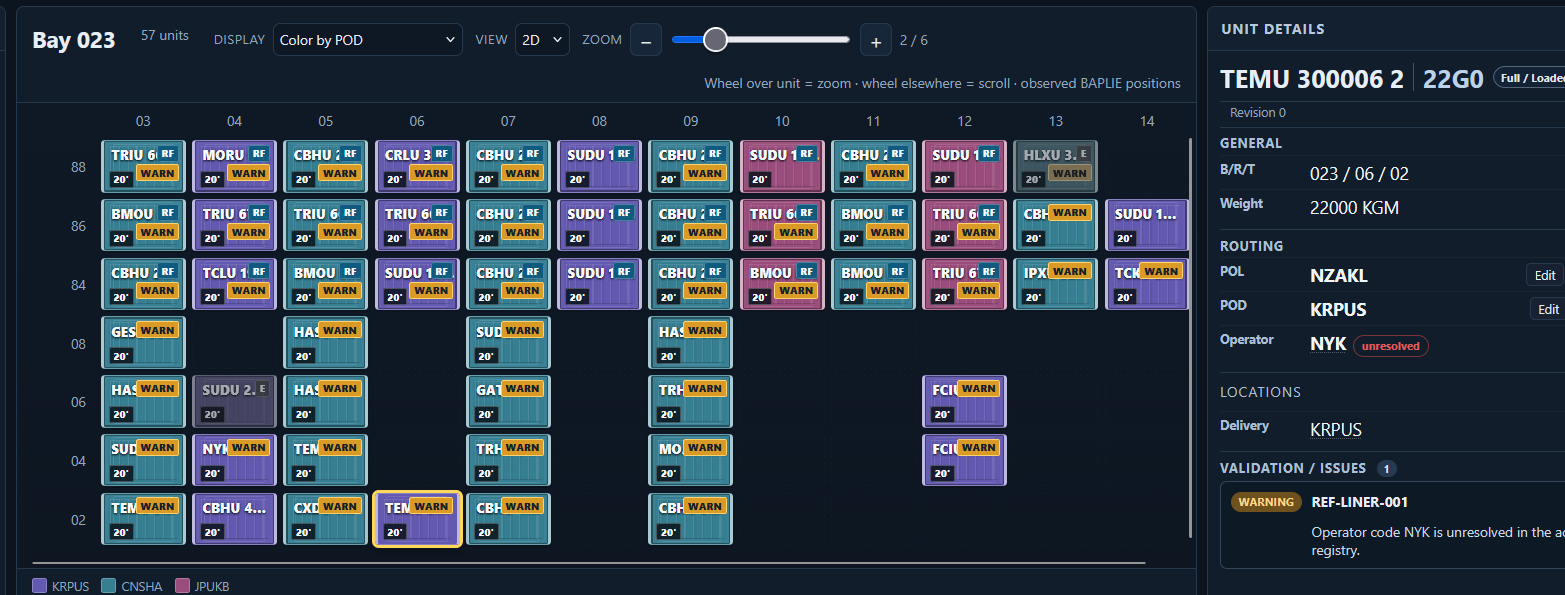
Visual vessel views can be presented using different operational color schemes, helping teams inspect the same stowage data from different perspectives.
 For whom
BaplAI Editor is designed for everyone involved in BAPLIE data handling and port call preparation.
Validate and prepare BAPLIE data for smooth port handover.
Validate data, reduce errors and ensure smooth handover.
Receive clean, consistent data and speed up port operations.
Improve data quality and reduce follow-up communication.
Handle EDIFACT data more efficiently and reliably.
Same data.
A completely different perspective.
Turn complex EDI data into a clear, validated bay view — and fix issues before handover.
Consulting & expertiseBeyond BAPLIE. Across the maritime message chain.
BOTUNGA AI supports shipping lines, terminals, agents, depots and maritime service providers in building, extending and improving EDIFACT communication with their operational partners.
Our consulting combines maritime process knowledge with practical message engineering — from message design and mapping to validation, migration, partner onboarding and automation.
We support both established message flows and the introduction of smarter, more automated operational workflows.
BAPLIE & MOVINSBAPLIE and MOVINS are closely connected within ship planning. While BAPLIE communicates vessel stowage information, MOVINS complements this flow with loading, discharge, restow and stowage instructions between vessel operators and terminals.
Implementation, migration, validation and partner-specific extensions of both message flows.
Maritime EDIFACT IntegrationBuild, extend and improve EDIFACT communication with carriers, terminals, agents, depots and other partners.
Mappings, validation rules, transformations, onboarding and automation.
IFTDGN & Operational MessagesValidation and improvement of dangerous-goods and other operational messages against agreed maritime rules and partner requirements.
TPFREP & Performance DataAudit and improvement of operational message flows, timestamps, performance data and partner-specific interfaces.
AI for Maritime OperationsCurious whether AI could support your maritime operations or EDI processes? Talk to us.
We have practical experience working with AI agents, workflow automation and AI-supported analysis and reporting. Together, we can identify where AI can create real operational value — from assisting EDI workflows and data validation to automating repetitive tasks and turning operational data into actionable insights.
Talk to our experts →See how BaplAI fits your operation.
We offer controlled demos and pilot projects in a secure, multi-tenant environment with role-based access. Get hands-on experience with your data and use cases — before full deployment.
Tell us briefly about your organization, operational role and current EDI challenges. Your request will be routed directly to the BOTUNGA AI maritime engineering team.
Your data stays yours.
From demo to pilot to production.
Access for the right people.
Test with your own EDIFACT files.
Much like Kiribati, where tradition meets modernity, BOTUNGA AI operates at the intersection of traditional logistics and the latest AI-driven developments.
In the Kiribati language, botunga means “to set in order / put in its place” — a fundamental virtue of safe vessel stowage.

Just as botunga calls for putting things in their proper order, we believe efficient processes are a form of care — for people, for operations, and for the planet. Every reduction in friction, rework and resource use lowers the climate impact of maritime logistics. That responsibility feels closest to home here: island nations such as Kiribati have added the least to the climate crisis, yet face some of its most immediate consequences.
 Ready to Pilot
See how BOTUNGA AI can help make the data clearer, more reliable and easier to hand over.
Request Demo or Pilot Access →